Hakai Luxvbalis Conservancy Area on the central coast of British Columbia is the largest marine park in the province and one of the better-known paddling areas in BC. This 304,000-acre (123,000-hectare) area encompasses a large archipelago of outstanding natural beauty and recreational value.
From fully exposed shorelines to rolling, forested hills and 3,000-foot (1000-metre) peaks, Hakai offers some of the most varied and scenic coastline in the province. Special features such as lagoons and reversing tidal rapids, beaches, all-weather anchorages, tombolos, and an intricate network of coves, inlets, and channels make it an ideal area for boaters, anglers, scuba divers, naturalists – and experienced sea kayakers.
Many parts of the so-called Discovery Coast are relatively unknown to kayakers. It will appeal to resourceful paddlers who seek a sense of pioneering, which includes laying some groundwork, discovering new fishing spots, wildlife watching, dealing with unknown tidal currents, and finding new campsites.
One of the better areas to paddle within Hakai is Spider Anchorage, southeast of Spider Island, which consists of sheltered bays, white sand beaches, and a multitude of marine life. Another popular anchorage is Pruth Bay on the north side of Calvert Island, reached via Kwakshua Channel. The recreation area has no developed facilities and has wilderness campsites only. Freshwater is available at some beaches, but creeks dry up during summer, and visitors are advised to carry a supply.
Paddlers can enjoy the many small straits, exposed coastline, and islands accessible from the communities of Bella Bella and Denny Island (Shearwater), such as the Goose Group in the western reaches of the Hakai Provincial Recreation Area. There is good camping on the south end of Campbell Island as you make you way through Hunter Channel towards Goose. Be prepared to paddle 5 miles (8 km) through the open water in Queens Sound between Campbell and Goose, the largest by far of the five islands gathered here. At the north end of Goose Island is a pure white beach composed largely of pulverized clam shells that when walked upon with bare feet emit a squeak not unlike the squeal of a sneaker on a gymnasium floor. This is truly an enchanted island. Note: There is no freshwater in the Goose Group.
Kayakers must be well prepared for poor weather and rough seas, which may occur at any time of the year. Fog can roll in very quickly, necessitating navigation by compass, and sea conditions can change from flat calm to 12- to 20-foot (4- to 6-m) seas within a matter of hours. The west coast of Calvert Island can be hazardous due to strong surf and should not be approached without knowledge of the locale, and then only under ideal conditions.
Winds during the summer are usually westerly or southwesterly, and on sunny days are often light or nil in the early morning, pick up midday to late afternoon, then die down in the evening. They can be extremely strong in the coastal inlets such as Burke Channel. Weather information can be picked up on VHF Channel 21B (161.65MHZ).
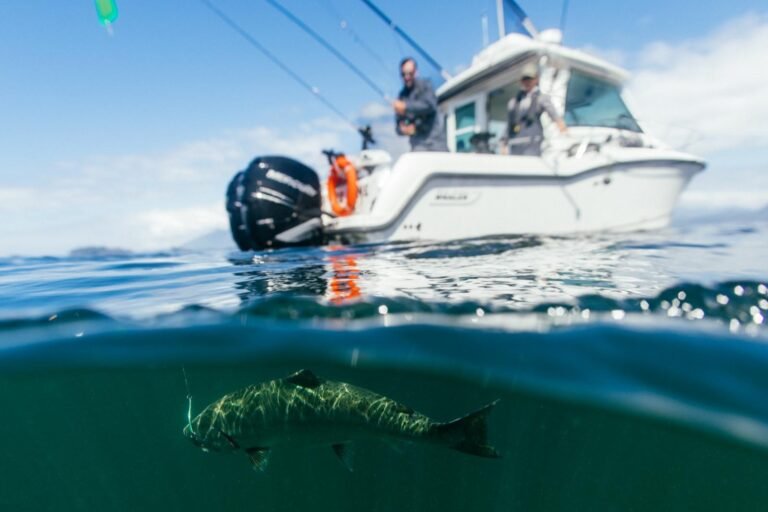
Hakai Pass in the Hakai Provincial Recreation Area is world-famous for its salmon fishing, particularly for chinook (spring), which are commonly caught on cut-plug herring. The area has a number of commercial floating fish camps and resorts. Besides salmon, there’s good fishing here for halibut, lingcod, and rockfish.
The midcoast is bald eagle country, and kayakers will also have the company of the ubiquitous kingfisher, common loon, cormorant, and sandpiper. In the Hakai Luxvbalis Conservancy Area, over 100 species of birds have been identified, ravens and ospreys among them. Feeding flocks of gulls, auklets, murres, and murrelets are numerous in the waters of Kildidt and Queens Sounds. Black oystercatchers, pelagic cormorants, surf birds, and both black and ruddy turnstones are also common.
The intertidal waters are home to an amazing number of marine life forms, and their existence and activities are controlled by the rhythmic movements of the tides. Every tide pool has its own distinctive inhabitants: mollusca, crabs, starfish, anemones, sea urchins, and many others.
Marine mammals to watch for include harbour seals, sea lions, beavers, river otters, orcas, and humpback whales. Offshore waters are home to minke, gray, and humpback whales, as well as porpoises and dolphins. Terrestrial wildlife includes black-tailed deer, mink, and wolves, as well as black, Kermode (Spirit Bear), and (on the mainland) the largest grizzly bears in the province.
Kayakers wishing to explore this remote wilderness can access it by sea or by air. BC Ferries’ Queen of Chilliwack stops at Namu, the closest settlement. Hakai is located across Fitz Hugh Sound from Namu, a busy shipping route also frequented by Pacific white-sided dolphins. Fuel and groceries are available at Bella Bella, Namu, and Dawsons Landing (Rivers Inlet). Private or chartered boats can be arranged from Vancouver, Port Hardy, and Bella Coola. Chartered and scheduled flights are available from Vancouver, Port Hardy, Bella Bella, and Bella Coola.
Hakai Luxvbalis Conservancy Area is located on the central coast of British Columbia, 6.2 miles (10 km) west of Namu and approximately 80 miles (130 km) north of Port Hardy on Vancouver Island.
Nearby Regions & Towns
Park Notices